
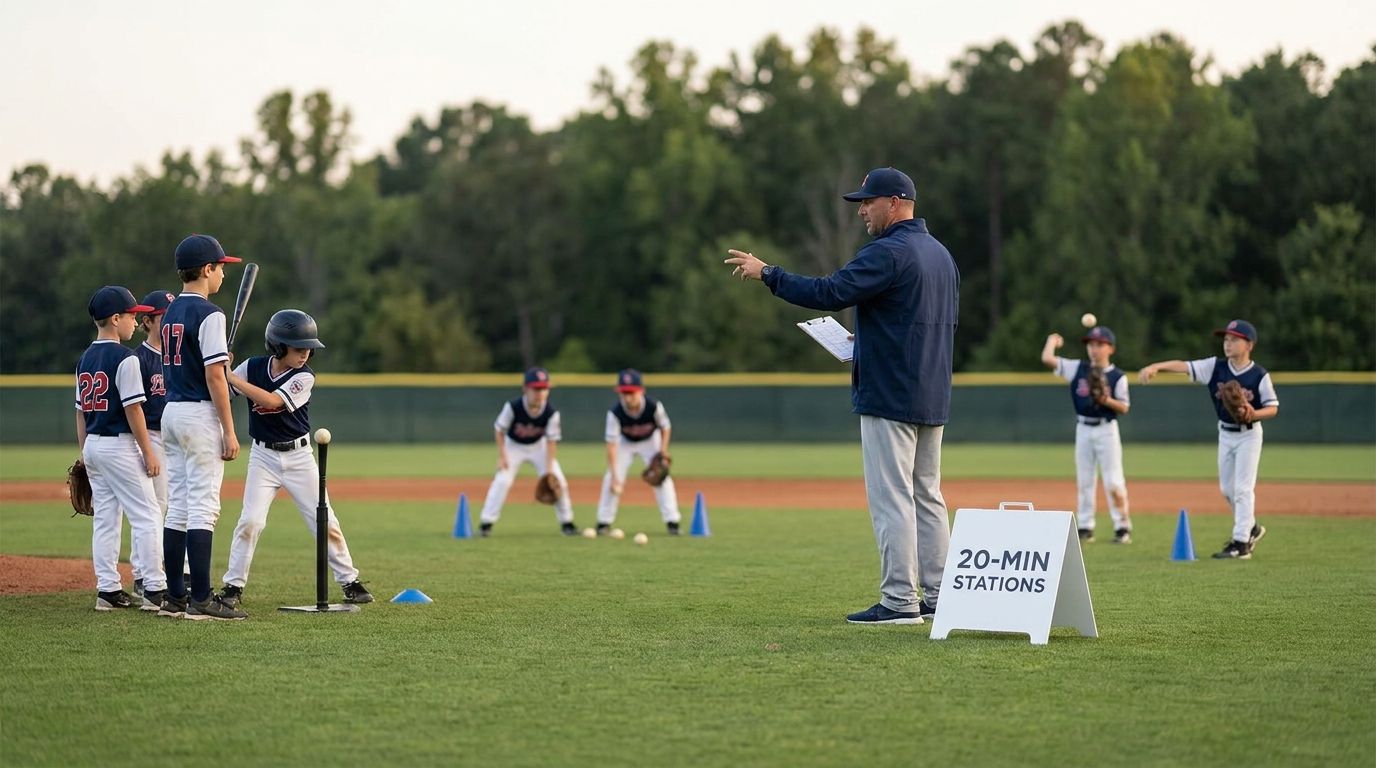
The 20-minute practice station system is a youth baseball practice format where players rotate through short, focused skill stations instead of standing in long whole-team lines. It helps you keep kids active, organized, and learning within the attention window most young players can handle.
If you coach a team with limited field time, uneven skill levels, and only a few helpers, this system gives you a clean way to run practice without chaos. You’ll see how to set up stations, choose drills, manage transitions, adapt by age group, and keep the pace safe and fun.
What Exactly Is The 20-Minute Practice Station System?
The 20-minute practice station system divides practice into separate baseball skill areas, then moves small groups through each one on a timed rotation. Instead of one long team drill, you run smaller, focused blocks for hitting, throwing, fielding, baserunning, or game play.
Picture a 60-minute practice with three stations. One group works on throwing mechanics, another fields ground balls, and another hits off tees or soft toss. After 20 minutes, each group rotates. By the end, every player has touched multiple parts of the game without waiting through a slow line.
The real value is not the clock alone. The value comes from matching the drill length to the age of the players, cutting idle time, and making every player part of the action. Youth baseball practice stations also let you coach in smaller groups, where correction is faster and players don’t disappear into the back of a line.
Why Does A 20-Minute Rotation Work So Well For Young Players?
A 20-minute rotation works because it fits the way kids focus, move, and learn during practice. Many players in the 6 to 10 age range can focus for roughly 12 to 24 minutes, so a 20-minute block lands in a practical coaching zone.
Long drills often look organized from the dugout, but they can turn passive for kids. One player fields, one player throws, and the rest wait. Once waiting becomes the main activity, attention drops and skill quality drops with it.
Shorter rotations give you a reset before boredom takes over. Players get a new task, a new coach voice, and a new movement pattern. That matters because youth sports retention is tied closely to fun, and organized sports often lose kids before the teenage years when the experience stops feeling active and enjoyable.
How Many Stations Should You Use In A Youth Baseball Practice?
Use three stations for a 60-minute practice and four stations for a 75-to-90-minute practice. That keeps the plan simple enough to manage and varied enough to hold attention.
For a 60-minute field slot, three stations of 20 minutes each usually work better than five rushed stations. You can cover hitting, fielding, and throwing in one session, then rotate baserunning or game situations into the next practice. If you try to squeeze in too much, you spend more time moving cones and explaining drills than coaching baseball.
For a 90-minute session, four 20-minute stations plus a short warmup and wrap-up can work well. A common layout is throwing, ground balls, hitting, and a small-sided game. The station count should match your space, equipment, and adult help, not a perfect-looking practice plan on paper.
What Are The 4 Biggest Benefits Of Baseball Station Rotation?
The four biggest benefits are more touches, less standing, more fun, and better game transfer. Those four gains are why station-based practice appears so often in youth baseball coaching guidance.
More touches come from smaller groups. A player in a line of twelve may wait minutes between reps, but a player in a group of four or five stays involved. More throws, more swings, more ground balls, and more baserunning reads give you more chances to correct habits.
Less standing improves behavior. Kids who are moving usually need fewer reminders. More fun comes from activity, variety, and quick wins. Better game transfer happens when one station includes decision-making, such as fielding and throwing to a target base instead of only rolling grounders with no purpose.
How Do You Set Up Your Station Rotation Before Practice Starts?
Set up your station rotation by choosing the skills, marking safe spaces, assigning groups, and giving each helper one clear job. The smoother the setup, the less you need to talk once practice begins.
Start with your field map. Put hitting stations away from throwing lanes. Keep tee work, soft toss, and bat work pointed toward a fence, net, or open area where players won’t cross. Use cones, buckets, or chalk lines so kids can see where each station starts and ends.
Then build groups by number and need. If you have twelve players, three groups of four are clean and easy. If skill levels vary, group players so each station can be coached at the right pace. A parent volunteer does not need to be a baseball expert if you hand them a simple drill card with the goal, setup, teaching cue, and stop signal.
Which 5 Station Types Should Every Youth Coach Use?
The five most useful station types are hitting, throwing, fielding, baserunning, and small-sided game play. These cover the core skills young players need without turning practice into a lecture.
Hitting stations can use tees, front toss, whiffle balls, or net work. Keep the cue short: balanced stance, eyes on the ball, finish the swing. Throwing stations can focus on grip, feet, target, and follow-through. Pair players close enough to succeed, then increase distance only when the throws stay accurate.
Fielding stations should include ready position, glove out front, feet moving, and a throw after the catch. Baserunning stations can cover running through first base, rounding the bag, listening to the base coach, and reacting to a ball in play. Small-sided game stations connect the skills, using controlled situations like runner on first, one out, ball hit to the right side.
How Do You Manage Transitions Without Losing Control?
Use a simple three-signal routine: stop, clean up, rotate. Players learn the pattern fast when you use the same signal every practice.
The first whistle or call means freeze and look at the coach. The second means return balls to the bucket, place bats down, and line up with your group. The third means jog to the next station. Keep the route the same every time so players don’t wander through throwing or hitting areas.
A 30-second changeover is realistic when equipment is already placed and groups know where to go. Don’t explain the next station during the rotation. Explain it at the station, with the group standing in the drill area and the equipment ready. The less dead air you create, the better the practice feels.
What Does A Sample 60-Minute Practice Plan Look Like?
A strong 60-minute plan uses three 20-minute stations with no long team line. If you need a warmup, fold it into the first station instead of adding ten minutes of standing and stretching.
Minutes 0-20: throwing and receiving. Players work in pairs, then add a target throw to a coach or bucket. Coaching cue: step toward the target and finish with the throwing hand across the body. Keep distances short enough that players can throw with control.
Minutes 20-40: fielding and throwing. Players field ground balls from a coach, secure the ball, and throw to a target base.
Minutes 40-60: hitting and baserunning. Half the group hits from tees or soft toss, and the other half runs through first base or rounds first on contact, then they switch inside the station if space allows.
How Should You Adapt Stations For Tee Ball, 8U, 10U, And 12U?
Adapt stations by changing the task difficulty, not the entire system. The 20-minute station practice plan can work across age groups when you adjust ball speed, distance, rules, and decision-making.
For tee ball, make stations shorter inside the 20-minute block. You can run two mini-activities in one station, such as five minutes of throwing to a target, five minutes of catching rolled balls, and five minutes of a game-like challenge with quick water or reset time. Keep explanations under a minute and demonstrate more than you talk.
For 8U and 10U, add more movement and simple choices. Players can field and throw to first, react to a base coach, or choose between two target bases. For 12U, stations can include pressure, scorekeeping, and game situations, such as cutoffs, relays, bunt defense, or live reads with controlled contact.
What If You Don’t Have Enough Assistant Coaches?
You can still use stations with one head coach if you simplify the activities and use parent helpers for structure rather than expert instruction. The goal is to keep players moving safely, not to turn every adult into a private instructor.
Give each helper one card. The card should say where players stand, what the drill is, what cue to repeat, and when to stop. A parent can run a tee station, roll ground balls, manage a target-throwing game, or supervise baserunning lanes with clear instructions.
If you have no helpers, use one coached station and two self-running stations. The coached station gets direct teaching. The self-running stations use low-risk drills, such as tee swings into a net, throwing at a fence target with foam or soft balls, or baserunning patterns with cones. Rotate yourself to the area that needs the most eyes.
How Do You Keep The Station System Safe?
Keep stations safe by separating hitting from throwing, controlling ball direction, and making every player wait behind a clear line. Safety comes from layout and routine, not from slowing practice down.
Set bat stations along a fence, into a net, or toward open space. No player should walk in front of a hitter, even during tee work. Throwing stations need a clear lane, a fixed partner, and enough distance from other groups that missed throws don’t cross into another activity.
Use softer balls for younger groups or tight spaces. Assign one ball bucket per station and keep loose balls out of foot traffic. End every station with equipment back in the same spot, so the next group enters a clean area instead of stepping into scattered bats, balls, and cones.
What Mistakes Should You Avoid When First Using Stations?
The biggest mistakes are overplanning, overtalking, poor spacing, and weak transitions. A station system should make practice simpler, not busier.
Don’t run drills that need five minutes of explanation. If players can’t understand it after one short demo, save it for an older group or a later practice. Don’t place two ball-flight stations near each other, especially hitting and throwing. Don’t let every station become a line with a new name.
Also avoid changing the rotation rules every week. Kids learn fast when the pattern stays the same. Use the same whistle routine, the same group names, and the same rotation direction. Once the structure feels familiar, you can swap drills without losing control.
What Tools Can Help You Plan Faster?
Use simple practice cards, a field sketch, and trusted coaching resources to reduce prep time. Digital tools can help, but a clean one-page plan is often enough.
Little League University offers practice plan ideas and age-based coaching material. USA Baseball’s coaching resources include practice design support and station-based thinking. Positive Coaching Alliance gives coaches player-centered tools that help practices stay active and enjoyable.
You can also build your own station template. Use four boxes: skill, setup, cue, and rotation note. Once you create a few reusable cards for hitting, fielding, throwing, baserunning, and small-sided games, planning becomes faster each week.
What Is The 20-Minute Practice Station System?
- Small groups rotate every 20 minutes
- Stations cover core baseball skills
- Players get more reps with less waiting
- It fits young players’ focus window
Build Your Next Practice Around Movement, Reps, And Fun
The 20-minute practice station system gives you a practical way to coach youth baseball without wasting half the session on lines, lectures, and loose transitions. You choose a few skills, divide players into small groups, set safe spaces, and rotate on a predictable clock. The format works because it respects how young players focus and how they enjoy learning: short bursts, clear tasks, and plenty of action. Start with three stations for your next 60-minute practice, keep the cues simple, and measure success by how many players are moving, learning, and smiling at the end.
References
- Understood.org: Normal Attention Span By Age
- National Alliance For Youth Sports: Why Kids Quit Sport
- Little League University
- Little League University: Minor League Practice Plan
- USA Baseball Coaching Resources
- Positive Coaching Alliance
- Active.com Youth Baseball
- Coach Baseball Right
- STACK: Youth Baseball Practice Stations
- The Aspen Institute Project Play

Jeffrey Wendel leads business development at Carts and Parts, a top E-Z-GO golf car dealership in Union City, IN. With more than three decades in powersports retail and small-business growth, he specializes in financing, customer experience, and marketing—and also coaches owners on scalable strategies. He is the author of Grand Slam Retirement.