
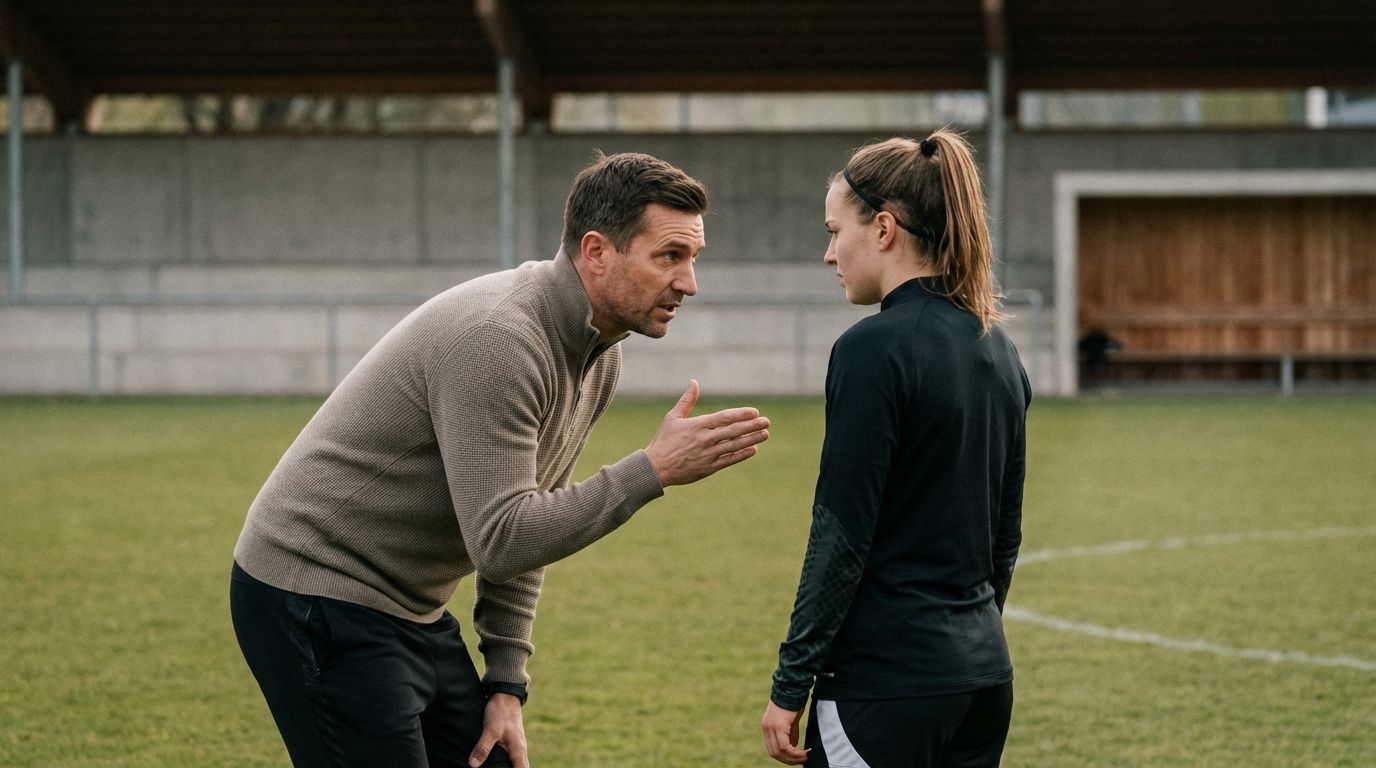
Players listen to feedback when you make it specific, timely, calm, and usable. If you want behavior to change, your feedback needs to tell a player what to adjust on the next rep, not just remind them what went wrong.
Good coaching feedback sharpens attention, protects confidence, and improves decision-making under pressure. When you deliver it with precision, you get better effort, faster correction, and more player ownership. This guide shows you how to say less, mean more, and build feedback habits that players actually trust.
How Do You Give Feedback To Players Without Hurting Their Confidence?
You protect confidence when you coach the action, not the person. Players shut down when feedback sounds like a label, a judgment, or a public verdict on who they are. They stay engaged when you point to a specific movement, decision, timing error, or tactical choice and tell them what to do on the next attempt.
That distinction matters more than many coaches realize. “You are unfocused” gives a player nothing useful to work with. “Get your eyes up before you receive and scan early” gives the brain a target. The player can execute that cue immediately, measure whether it helped, and stay emotionally steady during the correction.
You also protect confidence by separating the mistake from the identity of the athlete. Young players, in particular, absorb coach language fast. If your words suggest that mistakes define them, they begin to guard themselves instead of competing freely. If your words show that mistakes are part of skill building and can be corrected with one clean adjustment, you keep them open to instruction.
Use language that points forward. A player does not need a replay of failure. A player needs a usable correction. Replace “That was bad” with “Shorten the backswing and stay balanced through contact.” Replace “You lost your mark again” with “Check the shoulder sooner and recover goal side.” That kind of feedback keeps standards high without damaging the athlete’s belief in what they can fix.
Confidence also rises when your tone stays steady. Players read facial expression, volume, pacing, and body language before they absorb the actual words. If the delivery feels loaded with frustration, the message becomes harder to receive. A calm voice tells the athlete there is a solution. That is what keeps attention on performance instead of embarrassment.
When praise is deserved, make it useful too. Empty praise fades fast. Specific reinforcement teaches just as much as correction. “Good job” is pleasant but forgettable. “Good angle on the closeout, you took away the middle” tells the player exactly what to repeat. That is how confidence becomes earned, stable, and linked to execution.
When Is The Best Time To Give Players Feedback?
The best timing depends on the kind of correction you need to make. If the issue is simple and the player can adjust it right away, give one short cue near the moment. If the issue is emotional, repeated, or tied to bigger decision patterns, wait until the player can actually hear you and process what you are saying.
Players do not ignore feedback only because they dislike criticism. They also ignore feedback when it lands at the wrong moment. A player who just made a visible mistake in front of teammates may still be dealing with frustration, embarrassment, or anger. If you rush in with a long lecture, your words compete with the athlete’s emotional reaction, and most of the message gets lost.
Useful coaches think in timing windows. During the rep, keep it to one cue. Right after the rep, use a short correction tied to the next attempt. After a practice block, game segment, or video review, go deeper into patterns. That rhythm keeps feedback connected to performance without drowning the player in too much information.
You also need to match timing to player maturity and game state. A newer player often needs quick, simple direction because the mistake is still easy to identify and correct. A more experienced player may benefit more from a brief question that prompts self-assessment before you add your own point. In competition, timing gets even tighter. If the game is moving fast, a player can usually hold one instruction, not five.
Private timing often beats public timing for corrective feedback. A short word on the sideline, a quick check-in after the drill, or a calm conversation after practice gives the player space to listen without worrying about status in front of peers. Public correction has a way of turning a technical issue into a social issue. Once that happens, the player is managing pride, not just performance.
Good timing also means knowing when not to speak. If your correction would interrupt flow without improving the next action, hold it. If the player can discover the answer through the drill design, hold it. Coaches earn attention by speaking with purpose. When every mistake gets a comment, players start filtering you out.
What Kind Of Feedback Do Athletes Actually Respond To?
Athletes respond to feedback that is specific, actionable, and tied to a clear performance objective. They want coaching they can use, not commentary that sounds dramatic in the moment and useless five seconds later. If your message gives them a visible or physical adjustment, it has a chance to stick.
That means your best feedback often sounds plain. “Open up earlier.” “Win the inside lane.” “Stay taller at release.” “Call the switch sooner.” Those cues work because they direct attention to one controllable item. Players can take that instruction into the next rep and test it right away. The feedback becomes part of the learning cycle instead of background noise.
Vague feedback creates confusion. “Compete harder” may express urgency, but it does not identify a concrete fix. “Sprint through the recovery run and reset your stance faster” gives the athlete a real action. The more pressure increases, the more this matters. Under fatigue or game stress, players need short commands linked to visible behavior.
Athletes also respond better to feedback that recognizes what is already working. This does not mean softening standards. It means showing the player where the correction fits. “Your first step was sharp, now keep the chest over the ball on the finish.” That sentence tells the athlete that part of the movement is already sound and only one element needs adjustment. The result is better listening and cleaner carryover.
The delivery environment matters too. A smart correction can still fail if it arrives with sarcasm, public embarrassment, or obvious irritation. Players are far more likely to accept hard truth from a coach who is consistent, fair, and technically clear. Trust does not remove the sting of correction, but it makes the athlete less defensive and more willing to act.
Another point separates useful feedback from forgettable feedback: it is tied to standards the player already understands. If you say “Be better on defense,” you leave too much open to interpretation. If your team standard is “force outside, contain, and recover with active hands,” then feedback can connect to those shared expectations. Players listen better when they know exactly which standard they missed and how to meet it.
How Much Feedback Is Too Much For Players?
It becomes too much when your voice replaces the player’s own ability to read the game, feel the movement, and solve the problem. Constant correction may look active from the outside, yet it often creates dependence. Players start waiting for the coach to diagnose everything instead of learning to recognize errors on their own.
This is one of the most common coaching mistakes. A coach sees every flaw, comments on every flaw, and assumes more instruction will speed up development. The opposite often happens. The player becomes overloaded, attention gets split, and the quality of execution drops. Then the coach adds even more talk, which creates an even weaker learning environment.
You get better results by narrowing your focus. Pick the most important correction for the rep, drill, or stretch of play. Deliver that cue in a sentence the player can retain. Then give the athlete room to work. If the correction takes hold, reinforce it. If it does not, adjust the wording or the drill conditions. Keep the channel clear.
Player level matters here. Beginners usually need more frequent guidance because they are still learning what to notice. Experienced players need fewer interruptions and more responsibility for self-correction. If you coach advanced athletes the same way you coach beginners, you cap their growth. Their next step is not more dependence on your words. Their next step is better self-awareness and faster adjustment without constant external prompts.
Drill design can reduce the need for nonstop verbal feedback. If the task itself reveals success or failure, the player starts learning through immediate sensory information. Targets, constraints, scoring rules, spacing changes, and video review can all sharpen attention without turning every moment into a lecture. Coaches who build feedback into practice design usually need fewer words and get better learning.
Watch for signs of overload. If players nod but keep repeating the same mistake, they may be hearing you without processing you. If they look tense, hesitant, or robotic, your instruction load may be too high. Trim the message. Tighten the objective. Coaching improves when your feedback becomes easier to apply under real speed.
Should Coaches Give Feedback In Front Of The Whole Team Or In Private?
Corrective feedback usually works better in private. Public praise can build energy and reinforce standards across the group, but public correction often turns learning into embarrassment. Once a player feels exposed, listening drops and defensiveness rises.
This does not mean every coaching point needs a private meeting. Teamwide tactical reminders belong in front of the team. Effort standards, communication rules, transition responsibilities, and shape problems that affect everyone can be coached openly when you address the behavior rather than humiliating an individual. The line is simple: teach the group without making one player absorb all the social cost.
Private correction gives you more control over tone, detail, and player reaction. A quick one-on-one on the bench, a short walk after practice, or a brief film conversation lets you say what needs to be said without the athlete worrying about teammates watching every expression. That privacy often makes the message sharper because the player is not using energy to protect pride.
There is also a culture issue. When coaches correct harshly in front of everyone, players often copy the same habit with teammates. Soon the team starts policing mistakes with blame, eye-rolling, and finger-pointing. That weakens trust and makes communication worse under pressure. If you want players to communicate well with one another, your own feedback habits set the standard.
Praise is different. Public recognition can be powerful when it is deserved and specific. It tells the team what winning behavior looks like. “Great recovery sprint.” “Strong communication on that switch.” “Excellent body position in traffic.” Those comments reinforce standards without putting anyone on edge. Public praise works best when it is earned, not handed out as filler.
A useful rule is simple: praise publicly when it teaches the team what to repeat, correct privately when the goal is behavior change, and address team standards to the group without personalizing every mistake. That balance keeps your authority intact and makes players more willing to hear hard coaching when it matters most.
Why Do Players Ignore Feedback From Coaches Or Teammates?
Players ignore feedback when it feels vague, unfair, badly timed, repetitive, or socially loaded. They also tune out feedback when the speaker seems more interested in showing authority than helping solve the problem. Listening is not only about the words used. It is about whether the athlete trusts the source, understands the point, and believes the correction can help.
Bias plays a larger role than many teams admit. Players notice who gets patience, who gets public criticism, who gets repeated chances, and who gets labeled fast. Once they sense unequal treatment, every new piece of feedback gets filtered through that belief. The technical value of your correction may still be solid, but the player is now judging fairness before content.
Teammate feedback can fail for similar reasons. Players often reject peer correction when it sounds bossy, emotional, or disconnected from shared standards. A teammate saying “You need to stop messing this up” invites resistance. A teammate saying “Call the screen earlier so we can switch cleanly” gives a clear point tied to team execution. Precision lowers friction.
Trust also depends on whether feedback matches the player’s goal. If your athlete wants to improve and your message helps them move toward that goal, the odds of buy-in rise. If your message feels random, personal, or only negative, the player starts bracing for criticism instead of using it. Over time, this becomes a habit. You speak, they nod, and nothing changes.
Another reason players tune out feedback is volume. If every rep gets commentary, none of the comments carry weight. Your words lose value through overuse. Skilled coaches know how to make feedback feel important. They save longer conversations for moments that deserve them and keep in-the-moment instruction concise enough to act on.
You can also lose players when your standards are unclear. Athletes cannot consistently follow feedback if they do not know the target behavior. That is why strong communication starts before correction. When your team has defined language for spacing, tempo, coverage, effort, and communication, your feedback lands faster. The player hears the cue and knows exactly what standard it connects to.
How Can You Get Players To Accept Feedback And Self-Correct?
You get better buy-in when you involve players in the diagnosis before you deliver the correction. Ask what they noticed. Ask what they felt. Ask what option they saw late or missed early. When players take part in identifying the problem, they become more invested in the fix.
This does not mean turning every coaching moment into a long conversation. It means using short prompts that activate attention. “What did you see there?” “What broke down on the closeout?” “Where was your weight at contact?” Those questions make players process the rep instead of waiting passively for answers. Once they speak, your correction has a place to land.
Then add one cue. Not three, not six. One. “Open your stance sooner.” “Set the feet before the pass.” “Get the second hand through the tackle.” Keep the coaching point narrow enough that the athlete can own it immediately. After the next rep, ask again. “Better?” “What changed?” “Did you feel the difference?” This turns feedback into a loop rather than a speech.
Self-correction grows when players know what success feels like, looks like, and sounds like. You build that by reinforcing good reps with useful detail. If the athlete performs the movement well, name the winning element. “That one worked because your hips stayed square longer.” “That finish was better because you got the eyes up before contact.” These comments help the player build an internal model they can return to without your constant intervention.
Team culture matters here as well. Players accept feedback more easily when they know mistakes will be treated as coachable events rather than personal failures. That does not lower accountability. It improves it. When athletes feel safe enough to admit errors and skilled enough to fix them, they take more ownership of development. The standard rises because defensiveness drops.
If you want players to self-correct during competition, you need to train that habit during practice. Build pauses for reflection. Use film with short prompts instead of nonstop commentary. Let athletes explain what they saw before you add your view. The more often players practice diagnosing performance, the less they depend on sideline rescue.
What Feedback Makes Players Listen?
- Use short, specific coaching cues
- Correct the action, not the person
- Give feedback at the right moment
- Keep criticism private when possible
- Ask players to self-assess before adding instruction
Coach With Precision And Players Will Hear You
If you want players to listen, give feedback they can use on the next rep. Keep it specific, calm, and tied to one clear adjustment. Protect trust by correcting in the right moment, reducing public embarrassment, and applying standards fairly across the team. Build self-correction by asking players what they noticed before you add your cue, then reinforce what worked with the same level of precision. When your feedback becomes clear, consistent, and actionable, players stop bracing for criticism and start using your coaching to perform better.
References
- https://www.frontiersin.org/article/10.3389/fpsyg.2020.571552/full
- https://www.pheamerica.org/2020/best-practices-for-coaches-when-providing-feedback/
- https://miamioh.edu/ehs/news/2019/07/youth-sport2.html
- https://www.abca.org/magazine/magazine/2023-3-May-June/Ground_Rules_Importance_of_Communication.aspx
- https://nfhs.org/stories/feedback-to-win
- https://journals.sagepub.com/doi/10.1177/17479541231218665
- https://education.msu.edu/sport-coaching-leadership/2019/02/Five-principles-of-reinforcement
- https://coachesinsider.com/track-x-country/skill-acquisition-evidence-based-practices-for-detecting-and-correcting-errors-article/
- https://journals.sagepub.com/doi/10.1177/17479541251350035
- https://www.reddit.com/r/improv/comments/172f0k3
- https://www.reddit.com/r/volleyball/comments/1fb8vty
- https://www.reddit.com/r/rpg/comments/1556kzt

Jeffrey Wendel leads business development at Carts and Parts, a top E-Z-GO golf car dealership in Union City, IN. With more than three decades in powersports retail and small-business growth, he specializes in financing, customer experience, and marketing—and also coaches owners on scalable strategies. He is the author of Grand Slam Retirement.