
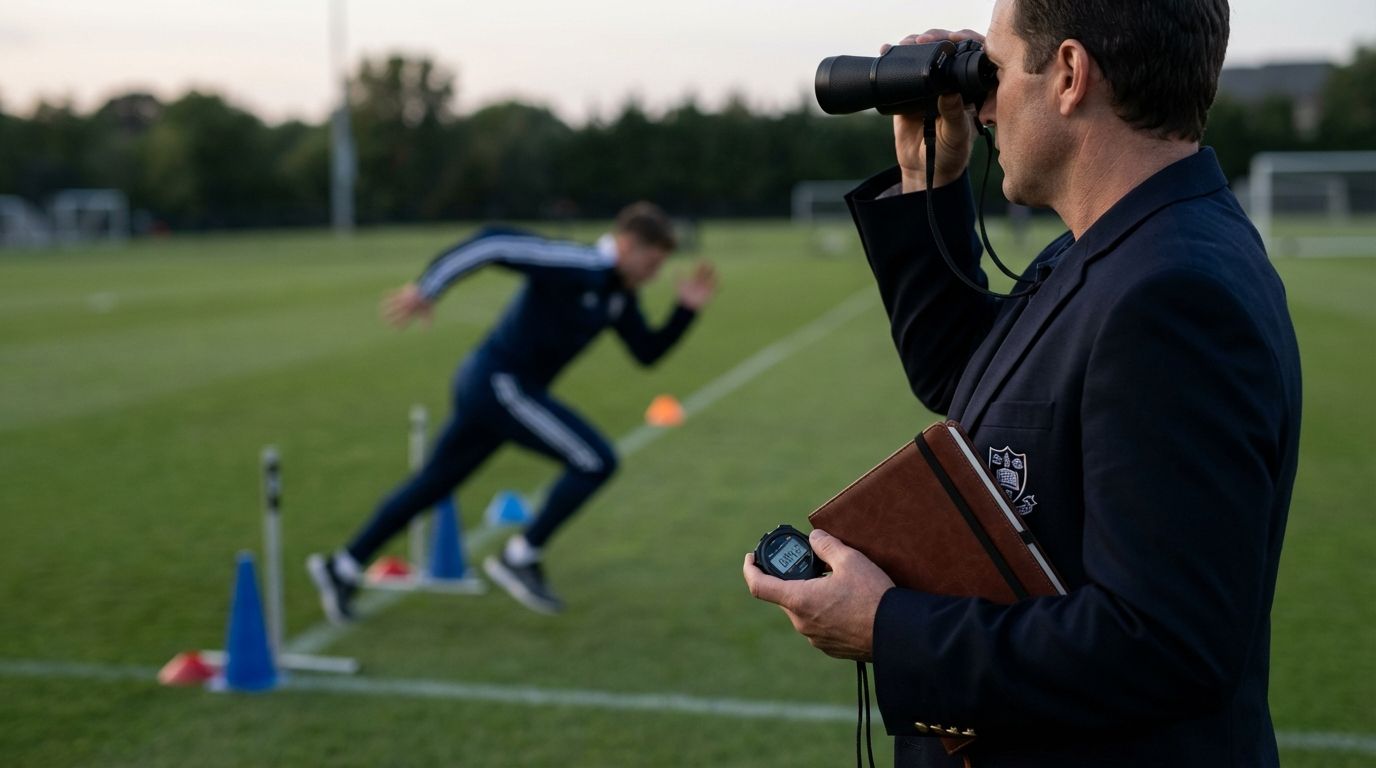
You can post an elite top speed and still get passed over if you don’t show repeatable, game-relevant actions that coaches trust under pressure. Top recruiters look for proof that your athletic tools translate, that you stay available, and that you communicate and compete in ways that raise a program’s weekly standard.
This guide breaks down the “quiet” evaluation points that separate two athletes with similar highlight reels. You’ll get practical ways to show game speed, repeatability, decision pace, durability signals, and recruiting-ready habits, plus how to time your outreach and visits around recruiting periods so coaches can actually engage.
What Do College Coaches Look For Besides Speed Or Top-End Velocity?
When a coach evaluates you, raw speed sits in the same bucket as raw strength, it’s a tool, not a guarantee. A staff’s job is to forecast whether your tools will hold up when the opponent is older, stronger, and tactically sharper. That forecast is built on translation: do your actions stay effective when the game gets messy, space shrinks, and mistakes get punished.
That’s why coaches keep coming back to traits that reduce risk. They want a player who executes a role without constant reminders, communicates without drama, and trains with consistency. Many staffs also filter hard for maturity and professionalism because those traits protect culture, limit distractions, and reduce missed time that comes from avoidable problems.
You should treat “hidden metrics” as three categories you can control: functional athleticism (how power and speed show up in the sport), reliability (availability, recovery, habits), and trust signals (coachability, communication, academics). If you build your development and your recruiting assets around those categories, you stop competing only on stopwatch numbers and start competing on what actually earns minutes.
Is “Game Speed” More Important Than A Fast 40-Yard Dash, And How Do Coaches Judge It?
Game speed is what coaches feel when they watch you affect plays early and often. It shows up as how quickly you see the next problem, make a decision, and get your body into the next action. You can look “fast” on film without winning a track meet because you arrive first, separate in two steps, and recover instantly after contact or a change of direction.
Coaches judge this by looking at your first three steps, your ability to re-accelerate, and how often you win the second effort. They also watch your spacing choices: do you arrive too early and drift out of the play, or do you time your movement so you arrive ready to execute? That timing piece is a major separator because it blends awareness, discipline, and physical readiness into one visible outcome.
If you want game speed to pop, clean up what happens between your headline moments. Sprinting once looks nice, sprinting repeatedly with purpose is what makes a staff picture you surviving a full college week. Your film should show sequences where you scan, move, act, and recover, then do it again without dropping intensity or losing technique.
What Tracking Metrics Matter Most (High-Speed Distance, Accelerations, Decelerations, PlayerLoad)?
Programs that use GPS and tracking don’t obsess over one magic number; they look for a profile that matches the demands of their style of play and their weekly load plan. High-speed running exposure matters because it reflects how often you hit stressful speeds in sport situations, not just in a controlled test. Acceleration and deceleration counts matter because they represent your engine and your brakes, and brakes are where a lot of athletes break down.
Recruiting value rises when a metric explains how you compete and how you stay healthy. If you’re a wide player or outside back in soccer, high-speed efforts and repeat sprints can align with the role. If you’re a central player, change of direction, decel control, and repeated short accelerations may align more. In other sports, the same idea holds: recruiters want evidence you can repeat high-intensity actions without losing mechanics.
You also need to understand the recruiting reality around sports tech: data impresses coaches only when it supports what they already see on film and when it’s presented cleanly. A screenshot dump of graphs rarely helps. A short, organized profile that lists your role, the tracking system used, and two to four consistent metrics over time can help a staff connect your output to durability and training habits.
Do Strength And Jump Tests (CMJ, Force Plates, RFD) Matter For Recruiting?
They matter when they explain why your movement looks the way it does, or when they predict how your body will hold up in college training. Coaches and performance staffs are often less interested in your “best day” number and more interested in what your numbers say about your explosive qualities and your injury risk. If two recruits look similar on film, testing can become a tie-breaker because it gives staff a development starting point.
Force-plate testing often highlights early-force outputs because those can separate athletes who look strong from athletes who express force quickly. A published case example from VALD shows an athlete whose force at 200 ms aligned with peak force, yet force at 100 ms was weaker, revealing a limitation that later metrics didn’t capture. VALD also notes research reporting that force at 200 ms shares about 60% variance with peak isometric force, while force at 100 ms shares only about 20–30% variance with peak force, which explains why early force can expose a gap that peak strength hides.
Use that idea to guide how you present yourself. If you test, present the outputs that connect to sport actions: early force, reactive strength (where relevant), jump height with context, and symmetry notes if you have them. Don’t lead with lab talk. Lead with what your testing says about first-step pop, braking control, and repeat power across a match or game.
What “Character” Or “Coachability” Signals Are Recruiters Watching For?
Coaches constantly evaluate how you manage feedback, stress, and teammates because those behaviors show up every day in college. The highest-value recruit is the one a staff trusts to raise training quality without creating extra work. Coaches watch your body language after mistakes, your effort when you’re not the focal point, and how you treat teammates you don’t benefit from socially.
Communication habits matter more than most families realize. If you respond late, send vague messages, or let adults do the talking, staffs can read that as a maturity risk. When you communicate like a college athlete, short, timely, specific, respectful, and organized, you make the coach’s job easier, and easier often wins over “slightly faster” when scholarship and roster decisions get tight.
You can make these traits visible without speeches. Ask sharp questions about development, role expectations, training loads, and academic support. Follow up with a clean recap message that confirms next steps. Show up early, manage equipment, and take warmups seriously. Coaches may never compliment these habits, but they record them mentally and they remember them when decisions get made.
How Important Are Academics And Eligibility Right Now, And Do SAT Or ACT Scores Still Matter?
Academic reliability remains a major recruiting filter because it affects admissions, eligibility, and scholarship planning. For NCAA Division I and Division II initial eligibility, standardized test scores are no longer required for students enrolling full time on or after August 1, 2023, which shifted the pressure toward core-course completion and transcript integrity. Coaches still get burned by late surprises, so they prioritize recruits who stay organized with classes and paperwork.
Even with the NCAA change, tests can still matter at the university level for admissions decisions or merit aid, depending on the school. That means your recruiting plan should keep flexibility: stay on top of core courses, keep grades steady, and confirm admissions testing expectations at target schools early. Waiting until senior year to learn an admissions requirement is the kind of mistake that turns a strong athletic fit into a scramble.
Your job is to remove uncertainty. Keep a clean academic resume ready, know your core-course progress, and communicate proactively when schedules change. Coaches recruit with limited time, and the recruit who makes eligibility and admissions easy becomes more recruitable, even when athletic traits are similar across a class.
When Can Coaches Actually Watch You Live Or Contact You, And Why Does Timing Change What Metrics Matter?
Timing controls access, and access controls perception. NCAA recruiting rules define recruiting activity and key concepts like contacts, contact periods, evaluation periods, and quiet periods. When coaches have limited in-person windows, they rely more on film, verified event performance, and clean communication, so your presentation has to be ready before the calendar opens.
During evaluation-heavy stretches, coaches may watch many athletes in a short time, then narrow quickly. Your “hidden metrics” during those windows become responsiveness, clarity, and having assets that load fast: a short highlight, full-game links, a current schedule, academic info, and a simple measurables list. Coaches also value consistency across multiple viewings more than one huge moment, since consistency predicts whether you can handle a college season.
Recruiting calendars vary by sport, and they change how you should plan campus visits and major events. If you plan a visit during a dead period, a coach may not be able to meet you, which wastes time and money. If you plan key showcases during windows when staffs can evaluate, and you alert coaches early with your schedule and jersey number, you increase your odds of being seen when they’re actually allowed to watch.
How Do You Package These Hidden Metrics So Coaches Notice Fast?
Coaches sort quickly, so your materials need to make decisions easy. Start with a short highlight that shows immediate impact within the first minute: scanning, first-step separation, defensive recovery, and execution under pressure. Add full-game film because serious staffs want context and off-ball habits, and they need to see what you do when you’re tired or not featured.
Your player profile should read like a clean scouting card. Include position, height and weight if relevant, graduation year, team level, GPA, test status if applicable for admissions, and a short list of functional performance markers: repeat sprint ability, acceleration, change-of-direction quality, jump or strength markers only if they’re recent and credible. If you have GPS data, keep it consistent and explain the system used and the time window, then list only a few metrics that connect to role demands.
Communication is part of the package. Send direct emails or messages that reference the program, the coach’s role, and the next evaluation opportunity. Include your upcoming schedule with dates, opponents, field locations, and kickoff times. When your schedule changes, update quickly. That behavior signals reliability, and reliability is one of the most underrated recruiting advantages you can control.
What Do College Recruiters Really Look For Beyond Speed?
- Game speed: quick decisions, timing, and repeat actions
- Repeatability: consistent high-intensity efforts under fatigue
- Durability: recovery habits and availability all season
- Trust signals: coachability, communication, academics
Turn Hidden Metrics Into Offers
If you want recruiters to take you seriously, stop treating velocity as the headline and start treating it as entry-level proof. Build film that shows repeat actions, decision pace, and role discipline, then support it with a clean profile that highlights reliability and durability. Use testing and tracking only when it clarifies what a coach sees and how you can be developed. Stay organized with academics and recruiting timing so you don’t lose opportunities to calendar issues or paperwork surprises. When your habits look college-ready before you arrive, coaches don’t need to guess, and offers come faster.
References
- Physical Attributes (Recruiting Discussion Thread)
- Traits Coaches Look For In Recruits (Beyond Skill)
- Rough Guideline For College Soccer Recruiting Process
- Questions To Ask A College Recruiter/Coach
- 7 Things College Coaches Lie To Recruits About
- VALD Performance: Explosive Strength And Early Force Metrics
- NCAA: Recruiting Calendars FAQ
- NCAA.org: Division II Test Score Requirement Update (Background)
- NCSA: 2025–26 NCAA Recruiting Calendar And Guide

Jeffrey Wendel leads business development at Carts and Parts, a top E-Z-GO golf car dealership in Union City, IN. With more than three decades in powersports retail and small-business growth, he specializes in financing, customer experience, and marketing—and also coaches owners on scalable strategies. He is the author of Grand Slam Retirement.