
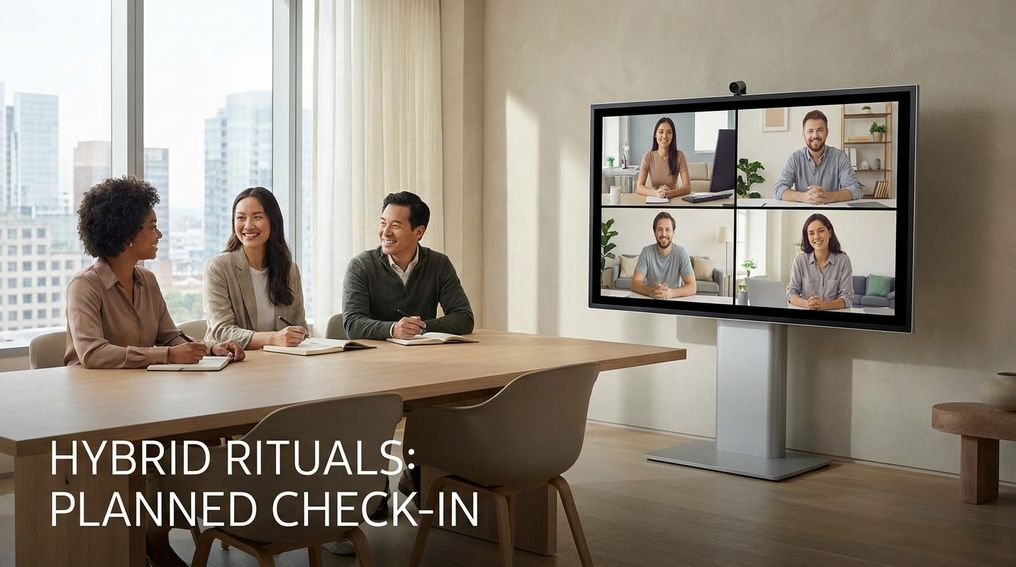
Hybrid team rituals help distributed employees coordinate, connect, and focus without adding more software. The best ritual gives your team a repeatable rhythm for communication, decision-making, and belonging.
If your team already has chat, video calls, project boards, shared documents, and task trackers, another subscription probably won’t fix the deeper problem. Hybrid work breaks down when people lack shared habits: where status lives, when decisions happen, how people reconnect, and how work moves without constant pings. This article explains how to use rituals to reduce noise, strengthen team culture, and make collaboration feel less scattered.
Why Do Hybrid Teams Feel Disconnected With So Much Software?
Hybrid teams feel disconnected when software multiplies communication without creating shared habits. More apps can give your team more places to talk, but they don’t automatically create clarity, trust, or follow-through.
Tool sprawl is real. Okta reports that the average organization deploys 93 apps, and large enterprises use 211 on average. That means your team can be surrounded by systems and still lose track of decisions, ownership, and deadlines. The problem isn’t always a missing feature; it’s often a missing rhythm.
Asana reports that workers spend 53% of their time on “work about work,” including communication, searching for information, switching between apps, and chasing status. Microsoft also reports that employees spend 57% of their time on communication across meetings, email, and chat, and 64% say they don’t have enough time or energy to do their job. When communication keeps expanding, people start mistaking activity for progress.
Hybrid work adds another layer. Microsoft reports that hybrid workers are more likely than fully on-site or remote workers to say collaboration has become harder. That makes sense: some people hear decisions in the office, some read them later in chat, and some miss them entirely. Better rituals give your team shared moments that reduce guesswork.
What Are Hybrid Team Rituals?
Hybrid team rituals are repeatable practices that help people coordinate work, build trust, and stay connected across locations. A ritual has a clear purpose, a predictable rhythm, and a human reason for existing.
A ritual can be as small as a Monday priority post or as structured as a weekly team retro. The value comes from repetition. People know when it happens, what to contribute, and what outcome to expect. That predictability lowers mental load because team members don’t have to keep asking where to share updates or how to get aligned.
Research discussed in Harvard Business Review connects rituals with trust, cohesion, and performance because rituals create shared experiences that people can count on. In a hybrid team, that shared experience matters because your people don’t naturally pick up hallway cues, desk-side updates, or casual moments between meetings. Rituals replace some of that missing social glue without forcing everyone into more calls.
The best rituals are not decorative. They solve a recurring work problem. If your team misses decisions, use a decision log ritual. If people feel invisible, use a recognition ritual. If managers keep asking for status updates, use a short async check-in rhythm that makes progress visible.
How Are Rituals Different From Meetings?
Meetings are scheduled conversations, but rituals are repeatable habits that create shared meaning and predictable coordination. A meeting can become a ritual only when it has a clear rhythm, purpose, and behavior pattern that people trust.
A typical meeting often starts with a vague agenda and ends with unclear ownership. A strong ritual has a known shape. People understand the prompt, the time boundary, the expected output, and where the result gets recorded. That makes it easier to participate without wasting energy on setup every time.
Think about the difference between a random status call and a five-minute async check-in. The status call requires everyone to be present at the same time, whether or not they need to speak. The async check-in lets each person share yesterday’s progress, today’s priority, and any blocker in one place. The team still gets visibility, but the ritual protects focus.
Rituals can also replace low-value meetings. A weekly decision digest can reduce repeated “what did you decide?” messages. A Friday handoff note can prevent Monday confusion. A standing office-hours ritual can move small questions out of scattered chat threads and into a predictable window.
Which Hybrid Team Rituals Actually Work?
The rituals that work best are simple, repeatable, and tied to a real team need. Start with connection, alignment, and reflection before adding anything new.
A digital watercooler creates a lightweight place for informal connection. This should not be another noisy channel where everything goes. Give it a simple prompt, a time limit, or a recurring theme so people know how to join without feeling awkward. A prompt like “share one work win and one non-work reset” gives the channel enough shape to keep it alive.
Virtual office hours reduce interruption overload. Instead of scattering quick questions across chat all day, a manager, team lead, or subject expert opens a recurring window for drop-in discussion. People can bring blockers, ask for clarification, or confirm decisions. This protects deep work because not every question becomes an immediate interruption.
A weekly team retro helps your team improve how work gets done. Keep it short and practical: what helped, what slowed the team down, and what needs one small change. The goal is not a long conversation about feelings. The goal is to remove friction before it becomes normal.
How Can You Build Connection Without Adding More Tools?
You build connection by adding intention to tools your team already uses. Use fewer channels with clearer rituals instead of buying another platform.
Start by mapping your current communication habits. Identify where status updates happen, where decisions get recorded, where questions go, and where recognition appears. If the answer is “everywhere,” your team doesn’t need more software. It needs a shared operating rhythm that makes each channel easier to use.
Then anchor rituals to existing habits. If your team already uses a project board, add a Friday “decision and dependency” note there. If chat is the daily gathering place, create one thread for the daily async check-in instead of opening multiple side conversations. If video calls already happen weekly, reserve the last ten minutes for a retro prompt rather than scheduling a separate session.
Connection also improves when people can see each other’s contributions. A shared gratitude board can help, but only if it stays specific. “Thanks for jumping in” is nice, but “thanks for documenting the client handoff so the team could move without rework” teaches the team what good collaboration looks like. That turns recognition into a culture-building habit.
How Do You Reduce App-Switching And Digital Fatigue?
You reduce app-switching by assigning each tool a job and each ritual a home. If people know where each type of work lives, they spend less time hunting and more time doing.
Digital fatigue often comes from unclear boundaries. A decision starts in a meeting, moves to chat, gets buried in an email, and later appears as a task with missing details. Your team then spends more time reconstructing the decision than acting on it. A decision log ritual fixes that by requiring every decision to land in one place with owner, date, and follow-up action.
Use a simple “home rule” for communication. Status belongs in the project system. Quick questions belong in chat. Decisions belong in a shared document or decision log. Longer thinking belongs in a written brief. You don’t need perfect discipline; you need enough consistency that people can find what matters.
Meeting overload also drops when rituals move routine updates out of live calls. Daily check-ins, weekly priority posts, and end-of-week handoff notes can all happen asynchronously. Live meetings should focus on discussion, tradeoffs, conflict resolution, and decisions that benefit from real-time attention. That keeps your calendar from becoming a substitute for clear writing.
How Do You Make Rituals Work Across Time Zones?
Rituals work across time zones when they are async-first and deadline-based. The goal is fair participation, not forcing everyone into the same hour.
Design each ritual around a contribution window. Instead of “everyone joins at 9,” use “everyone posts by the end of their morning.” That lets people participate during normal working hours and still gives the team a shared rhythm. It also reduces the hidden burden placed on people who always join outside their ideal workday.
Use written prompts that don’t require explanation. A strong async standup asks for priorities, blockers, and help needed. A weekly retro asks what to keep, stop, and change. A handoff ritual asks what changed, what’s waiting, and who owns the next move. Good prompts reduce the need for follow-up meetings.
Time-zone rituals need clear closure. Someone must summarize the thread, name decisions, and confirm owners. Without closure, async work turns into a pile of comments. With closure, it becomes a reliable way to move work across locations.
How Do You Handle The “We Don’t Have Time” Objection?
You handle the time objection by making rituals smaller than the confusion they replace. A good ritual should reduce rework, repeated questions, and status-chasing.
Many teams resist rituals because they sound like extra process. That concern is valid if the ritual has no clear output. A vague coffee chat can feel like one more obligation. A focused fifteen-minute office-hours slot that clears blockers can save hours of scattered messages.
Use a simple rule: no ritual without a job. If a ritual supports alignment, define the update format. If it supports connection, define the participation pattern. If it supports learning, define the question and the action that follows. A ritual should earn its place in the team’s week.
Start with one ritual for one pain point. If people complain about missing decisions, don’t launch a full team culture plan. Add a decision recap ritual after every major discussion. Keep it for a few weeks, review whether repeated questions go down, then decide whether to keep, change, or remove it.
How Do You Measure Whether Team Rituals Are Working?
You measure rituals by checking whether they reduce friction and improve team clarity. Useful signals include fewer repeated questions, faster handoffs, better participation, and clearer ownership.
Use practical measures your team can observe. Track how often decisions need to be repeated. Review whether blockers surface earlier. Notice whether people come to meetings with better preparation because async updates already gave them the background. These signs tell you whether the ritual is helping real work.
Engagement matters too. Gallup reports that only 23% of employees worldwide are engaged at work, which gives managers a reason to take connection seriously. Rituals won’t fix every engagement issue, but they can make people feel seen, informed, and included. That matters in hybrid teams where visibility is uneven.
Ask one short review question every month: “Which ritual helped your work, and which one should change?” Keep the answers tied to action. If a ritual has low participation and no clear value, revise it or remove it. Rituals should stay useful, not ceremonial.
Best Rituals For Hybrid Teams
- Daily async check-ins
- Weekly 15-minute huddles
- Monthly coffee roulette chats
- Quarterly in-person offsites
- Shared digital gratitude board
Build The Rhythm Before You Buy The Tool
Better hybrid work starts with shared rhythm, not a longer software stack. Your team needs clear places for updates, decisions, questions, recognition, and reflection. Hybrid team rituals give those habits a repeatable shape so people can stop chasing information and start doing better work. Choose one recurring pain point, build one small ritual around it, and measure whether it reduces noise. If the ritual makes work clearer, keep it; if it adds clutter, change it.
References
- Microsoft Work Trend Index
- Okta Businesses At Work
- Asana Anatomy Of Work Global Index
- Gallup State Of The Global Workplace
- Harvard Business Review: The Power Of Rituals In Life, Business, And Teams
- Harvard Business Review: How To Make Hybrid Work Work: 3 Rituals For Your Team.

Jeffrey Wendel leads business development at Carts and Parts, a top E-Z-GO golf car dealership in Union City, IN. With more than three decades in powersports retail and small-business growth, he specializes in financing, customer experience, and marketing—and also coaches owners on scalable strategies. He is the author of Grand Slam Retirement.