
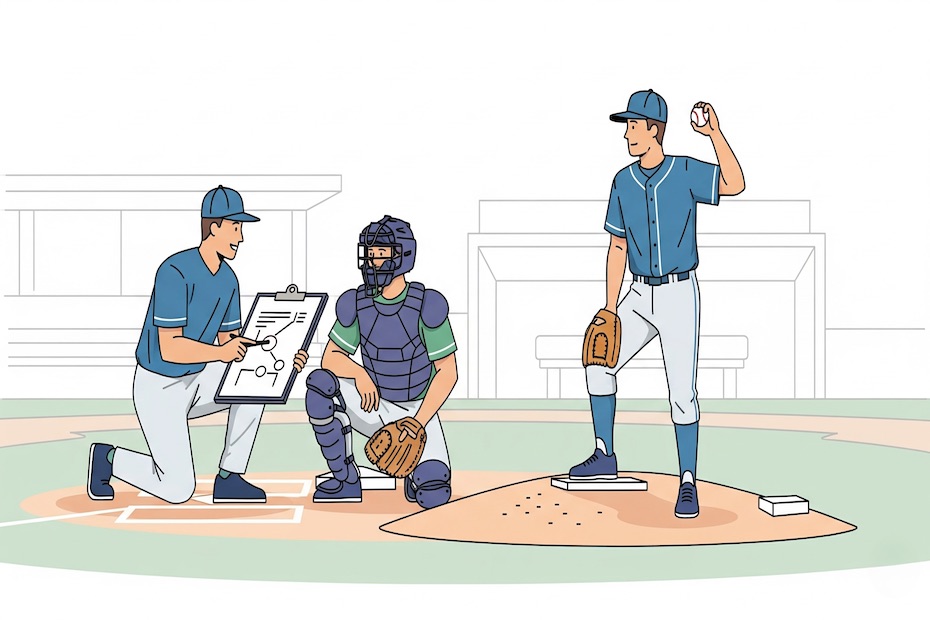
You improve pitch calling strategies by aligning pitcher strengths with hitter weaknesses, using pitch sequencing, and adjusting based on game situations to remain unpredictable.
This guide equips you with the tools to elevate your game calling. You’ll learn how to read hitters, apply count-based strategies, mix pitches effectively, integrate technology, and avoid the pitfalls that make teams predictable.
What is the role of pitcher strengths and weaknesses in pitch calling?
The core of effective pitch calling starts with understanding your pitcher. If they command a two-seam fastball and slider, you emphasize those. If their changeup is inconsistent, you minimize its use in tight spots.
You also need to evaluate stamina. A pitcher may be effective with a curveball in the first three innings but lose bite later. Recognizing those changes in real time prevents costly mistakes.
On the other side, you study opposing hitters. If the scouting report shows a batter struggles against breaking balls away, you build that into your plan. Conversely, avoid feeding their hot zones, even if it means leaning heavily on secondary pitches.
How do you read hitters to inform pitch selection?
Reading hitters gives you real-time intelligence. Watch stance, stride, and swing timing. A batter standing off the plate is vulnerable to inside heat. A hitter crowding the plate is open to off-speed away.
You also monitor body language. If a hitter fouls pitches late, they’re behind on velocity. If they roll over grounders, they’re vulnerable to off-speed low and away. These cues direct your calls.
In-game adjustments are crucial. A batter may look overmatched in the first at-bat but adjust by the third. Track their responses, and don’t assume the same pitch will work twice.
Why does situational pitch sequencing matter?
Pitch sequencing is how you set hitters up for failure. You don’t just throw pitches in isolation—you build patterns to disrupt timing and expectations.
For example, following a high fastball with a low breaking ball changes the hitter’s eye level and forces difficult adjustments. Throwing an inside fastball after a changeup away makes the next swing uncomfortable.
Situational awareness sharpens sequencing. With runners in scoring position, you call pitches designed for weak contact or strikeouts. With a big lead, you may lean toward efficiency, prioritizing ground balls and quick outs.
Apply count-based strategies effectively
Count leverage dictates pitch selection. At 0-0, you establish control with your most reliable strike pitch. At 1-2, you can expand the zone and tempt chases. At 3-1, you attack with your best strike pitch to avoid walking hitters.
When ahead in the count, you put hitters on the defensive with breaking or off-speed. When behind, you call pitches your pitcher can command consistently, usually fastballs or cutters.
Having a clear, practiced plan for each count removes hesitation. Your pitcher trusts the sequence, and hitters face consistent pressure.
Mix locations, speeds, and eye levels
Hitters thrive on patterns. By mixing pitch speeds and locations, you strip away that comfort. A fastball up followed by a slider down makes it nearly impossible to square both.
Changing eye level keeps hitters guessing. A curveball below the knees after a high fastball creates whiplash in timing. Working inside and outside prevents hitters from diving over the plate or leaning into predictable zones.
Velocity shifts matter just as much. An 85-mph changeup looks slower after a 94-mph fastball. A 75-mph curveball following a changeup feels impossible to time. This manipulation turns average pitchers into tough outs.
Adapt mid-game based on feedback
Sticking to a rigid script gets you beat. The best pitch callers adjust constantly. If a hitter is squaring up fastballs, you pivot to off-speed. If a slider is losing bite, you reduce its use.
Feedback loops drive these changes. Listen to your catcher—they see swings up close. Pay attention to pitcher body language; if mechanics slip, don’t force difficult pitches.
Adapting doesn’t mean abandoning strategy. It means fine-tuning. Keep your overarching plan but shift pitch frequencies, locations, or pitch usage when the game demands it.
Strengthen communication with pitcher and catcher
Pitch calling lives or dies on trust. Your pitcher must believe in your calls, and your catcher must execute signals with precision.
Pre-game meetings align everyone. Review scouting reports, pitcher strengths, and situational strategies. During the game, mound visits help reset nerves and clarify approach.
Technology adds efficiency. Systems like PitchCom allow encrypted signals from catcher to pitcher, eliminating sign-stealing risks and improving tempo. Use it to simplify communication and reduce confusion in critical moments.
Avoid predictability in your sequences
Hitters at higher levels thrive when they can guess. If you always follow a fastball with a breaking ball, they’ll time it. If you always call a slider in 0-2 counts, they’ll adjust.
Unpredictability is your weapon. Vary pitch types in the same counts. Occasionally call a first-pitch off-speed. Use fastballs in unconventional locations to disrupt expectations.
Balance is key. Being unpredictable doesn’t mean random. It means building sequences that force hitters to think instead of react.
Use technology and analytics for smarter decisions
Data is reshaping pitch calling. Advanced analytics provide heat maps of hitter weaknesses, pitch effectiveness, and success rates by count.
Video systems allow instant replay of at-bats to spot adjustments. Velocity and spin rate tracking helps you know if a pitcher’s breaking ball still has life or if fatigue is setting in.
These tools don’t replace experience; they enhance it. Combine your knowledge with analytics, and you make sharper, more defensible calls in every inning.
Learn from common pitch calling mistakes
The most frequent mistake is forcing a pitcher to throw their “best pitch” even when they don’t have it that day. If the curveball isn’t landing, stop calling it in key counts.
Another mistake is ignoring hitter adjustments. A hitter who looked lost in the first at-bat may crush the same pitch in the third. Adjust with them.
Lastly, overcomplicating sequences can backfire. Don’t get so deep into strategy that your pitcher loses confidence. Simplicity with precision often beats complexity without execution.
Elements you should track every inning
You gain an edge by keeping running notes:
- Which pitches each hitter struggles with
- How hitters adjust in later at-bats
- Whether certain pitches are flattening as the game progresses
- Count leverage success rates (fastballs landing vs. breaking balls missing)
- Feedback from catcher and pitcher
This tracking ensures you aren’t just reacting—you’re leading the game plan with intention.
What are the best pitch calling strategies?
- Align with pitcher strengths
- Exploit hitter weaknesses
- Sequence pitches by count
- Mix speeds and locations
- Communicate clearly
- Stay unpredictable
- Adjust mid-game
In Conclusion
Building effective pitch calling strategies means combining preparation, in-game adjustments, communication, and unpredictability. When you read hitters well, sequence with intent, and keep your pitcher confident, you control the tempo of the game.

Jeffrey Wendel leads business development at Carts and Parts, a top E-Z-GO golf car dealership in Union City, IN. With more than three decades in powersports retail and small-business growth, he specializes in financing, customer experience, and marketing—and also coaches owners on scalable strategies. He is the author of Grand Slam Retirement.