
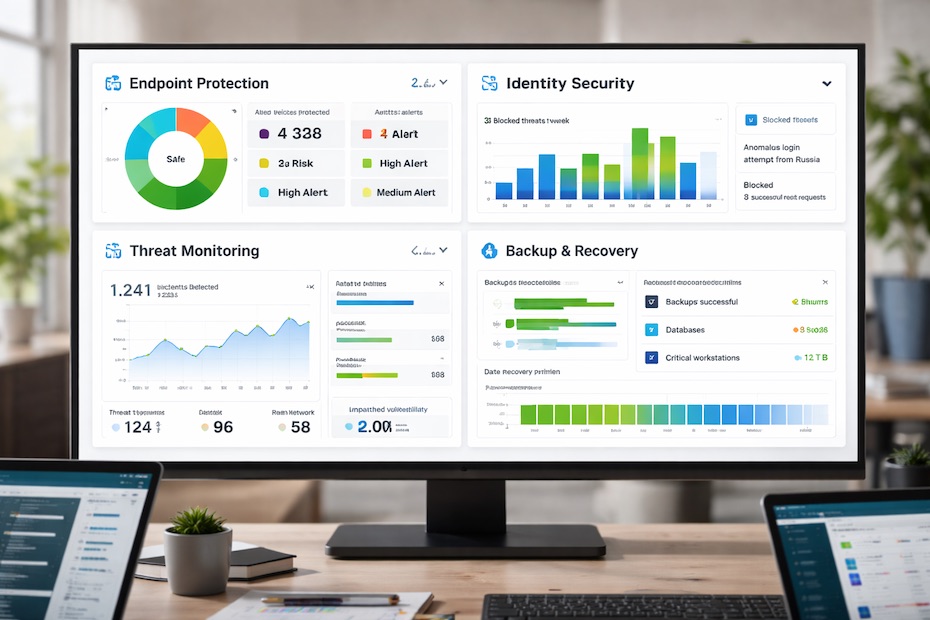
Modern businesses protect themselves best by combining endpoint security, identity controls, email protection, data backup, and continuous monitoring into a single, coordinated security stack. No single product blocks every threat, but these five tool categories consistently reduce breach risk and financial impact.
You are about to see how today’s most effective cybersecurity tools work together, what real-world data shows about their value, and how to prioritize adoption without overengineering your environment. This guide stays practical, current, and aligned with how attacks actually unfold in 2026.
Why do modern businesses need a cybersecurity tool stack?
Modern attacks target people, endpoints, and identity systems rather than perimeter firewalls alone.
Current breach analysis from Verizon shows ransomware involvement in roughly 44% of breaches, with stolen credentials remaining a frequent entry path. That pattern explains why layered security matters more than isolated tools. You cannot block ransomware reliably if you only secure email, and you cannot stop account takeover if you only deploy antivirus.
Small and mid-sized businesses face the same threat actors as large enterprises, just with fewer internal resources. Attack automation has reduced the skill required to launch campaigns, which shifts the advantage toward defenders who deploy the right baseline tools early. A focused tool stack reduces exposure without forcing you into a full security operations buildout.
Tool 1: Endpoint Detection and Response (EDR)
Endpoint Detection and Response platforms monitor laptops, desktops, and servers for suspicious behavior rather than relying on known malware signatures.
EDR tools track process execution, lateral movement attempts, and privilege escalation signals in real time. This matters because ransomware commonly activates after attackers establish persistence. When endpoints are instrumented correctly, EDR platforms can isolate compromised devices before encryption spreads across shared storage.
Traditional antivirus still has value, but it lacks the behavioral telemetry that modern attacks exploit. EDR gives you visibility into what actually happens on endpoints, which aligns with how ransomware operators work today. Organizations that deploy EDR consistently reduce dwell time, limiting operational damage.
Tool 2: Multi-Factor Authentication and Identity Protection
Multi-factor authentication (MFA) blocks attackers even when passwords are stolen.
According to public guidance from CISA, phishing-resistant MFA provides the strongest defense against credential-based attacks. That recommendation reflects breach data showing compromised credentials as a leading initial access vector. MFA disrupts automated login abuse that would otherwise bypass network defenses.
Identity tools also help enforce least-privilege access across cloud services, internal apps, and remote logins. When MFA is applied consistently, attackers must compromise physical devices or secure tokens rather than passwords alone. That added friction removes the low-cost advantage attackers depend on.
Tool 3: Email Security and Phishing Defense
Email remains a primary delivery channel for malware, credential theft, and account compromise.
Modern email security tools analyze sender reputation, message content, and link behavior before delivery. They also provide post-delivery remediation, pulling malicious messages that evade initial filtering. This layered inspection reduces user exposure while preserving normal communication flow.
Human-targeted attacks persist because email remains universal and trusted. When email security is paired with MFA, phishing success rates drop sharply. Attackers may still send messages, but fewer attempts convert into usable credentials or malware execution.
Tool 4: Backup and Disaster Recovery Systems
Backups protect business continuity when prevention fails.
Recent industry reporting summarized by major vendors shows that only about one-third of organizations that paid ransoms recovered their data successfully, while recovery without paying increased. That trend confirms a hard reality: payment does not guarantee restoration. Tested backups do.
Modern backup tools support immutable storage, versioning, and rapid recovery workflows. These features block attackers from encrypting or deleting backup data. When backups are isolated and tested regularly, ransomware shifts from an existential threat to a recoverable disruption.
Tool 5: Continuous Monitoring and Security Visibility
Security monitoring tools consolidate alerts across endpoints, identity systems, and cloud services.
Centralized visibility allows you to detect correlated activity rather than isolated events. A failed login attempt may seem harmless alone, but paired with endpoint anomalies and unusual file access, it signals active compromise. Monitoring platforms surface these patterns before damage escalates.
Many organizations now align monitoring efforts with guidance from NIST Cybersecurity Framework 2.0. This structure maps detection, response, and recovery capabilities to measurable outcomes. Even small teams benefit from structured visibility that reduces blind spots.
How do these tools work together in real operations?
Effective cybersecurity depends on interaction, not isolation.
Email security blocks initial phishing attempts, while MFA prevents stolen credentials from granting access. If a device is compromised anyway, EDR detects abnormal behavior and isolates the endpoint. Backups ensure recovery if ransomware executes, and monitoring tools connect signals across systems to guide response.
This layered approach mirrors how attackers chain tactics. Breaking any link in the chain raises their cost and reduces success. Businesses that deploy tools in coordination see fewer full-scale incidents than those relying on a single defensive control.
How should businesses prioritize cybersecurity investments?
Start with identity and endpoints, then expand outward.
Credential abuse and endpoint compromise appear consistently in breach investigations, making MFA and EDR high-impact investments. Email security follows closely due to its role in initial access. Backups and monitoring complete the stack by addressing recovery and visibility.
Budget constraints matter, but prioritization matters more. Implementing these tools incrementally still delivers compounding protection. Each addition reduces reliance on perfect user behavior and increases resilience against automated attacks.
What cybersecurity tools do businesses need most?
- Endpoint detection to stop ransomware spread
- Multi-factor authentication to block credential abuse
- Email security to reduce phishing risk
- Backup systems for recovery
- Monitoring tools for early threat detection
Build Security That Scales With Your Business
You protect your organization best by investing in tools that align with how attacks actually happen. Endpoint visibility, identity protection, email defense, reliable backups, and centralized monitoring form a security baseline that scales as operations grow. These tools reduce risk without demanding enterprise-level staffing or complexity. When implemented together, they shift cybersecurity from reactive cleanup to controlled resilience. The earlier you establish this foundation, the less leverage attackers gain as your business expands.

Jeffrey Wendel leads business development at Carts and Parts, a top E-Z-GO golf car dealership in Union City, IN. With more than three decades in powersports retail and small-business growth, he specializes in financing, customer experience, and marketing—and also coaches owners on scalable strategies. He is the author of Grand Slam Retirement.